


Facing the Ministry of Justice’s decision that the remaining houses in Taipei’s Huaguang Community (華光社區) would be demolished within three days starting yesterday, nearly 200 residents and activists yesterday marched in the capital to protest the forced removal of Huaguang residents, while calling for “living justice.”
After setting up a simple altar with fruit on it and a wooden sign that reads: “living justice” on a corner of the old community — which they said represented a parting ceremony for the community and the death of justice — the activists bowed their heads in tribute before heading off on their march.
Dozens of young activists carried wooden doors, window frames, ladders and other furniture on their shoulders as they joined the protest march.
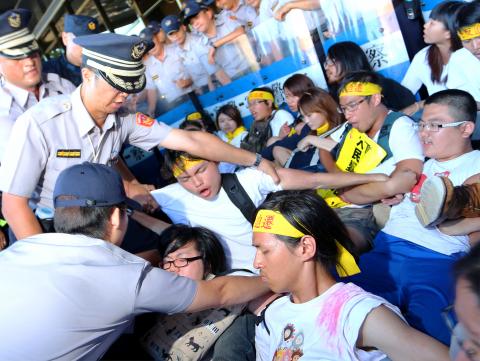
Photo: Wang Yi-sung, Taipei Times
“We will use our bodies to show the government that what they are relentlessly tearing down are people’s homes,” a representative of the group said. “The [then-Chinese Nationalist Party (KMT)] government tacitly agreed for people to build homes in the community after the Nationalist government retreated to Taiwan in 1949. The government also did not impose residential planning controls during the periods of migration from rural to urban areas in the 1970s, and allowed more people to move into the area, but now it wants to erase its mistakes through violent demolitions.”
Holding a portrait of his deceased mother at the protest, a 60-year-old man surnamed Chen (陳) said his mother, Cheng Yi-mei (鄭依妹), had bought a house in the community with money she made working as a domestic servant for more than 40 years. However, five years ago, aged 87, she was faced with a “cold-blooded and cruel government” that threatened to fine her for benefiting from “illegal occupation” of government land if she did not move.
“She has done nothing to deserve being continually threatened over the past five years until her death this year... Many residents had no choice but to move because they could not cope with the heavy fines, which included interest payments of 5 percent, but I will not give in, not only for my mother, but because I can’t stand a government that treats its people like dirt,” Chen said.
Ho Hui-fen (侯惠芬), whose husband was born and raised in the community, said her parents-in-law have always abided by the law, paid their water and electricity bills, and have lived in Huaguang all their lives after they came to Taiwan, so it is unfair that they are suddenly forced to move and asked to pay a fine of more than NT$6 million (US$200,000).
Another protester, a young woman in her early 20s, said she began caring about similar controversial developments, including the Losheng (Happy Life) Sanatorium (樂生療養院) and the Wenlin Yuan (文林苑) urban renewal project, when she was a university student, and joined the movement for the rights of Huaguang residents because “the government always uses empty promises of economic development to repress underprivileged groups in society.”
In front of the Executive Yuan, activists staged three dramas, expressing that the public are hurting and bleeding as the government uses lawsuits against them; are being made homeless by land expropriations and demolitions; and are dying as the government hands down heavy fines while benefiting from offering regained land to companies for commercial use.
After the parade ended on Ketagalan Boulevard near noon, activists held an impromptu protest in front of the Ministry of Justice, where clashes with police broke out with several activists forcibly removed, put on police buses and dropped off at other locations.
Four activists were required to give their personal information to police before being released.

NATIONAL SECURITY: Authorities are working to confirm the identities of the military personnel involved and investigating possible illegal conduct and regulatory violations Authorities are probing possible national security implications after Kinmen police and immigration officers on Sunday found a Chinese woman allegedly posing as a tourist while engaging in prostitution involving more than 10 military personnel. The woman, surnamed Chen (陳), has since been deported, authorities said, adding that investigators are still working to confirm the identities of those implicated, as the records only listed code names and aliases. The case stemmed from a report received by the Kinmen District Prosecutors’ Office on Friday last week from the Jinhu Precinct of the Kinmen County Police Bureau. On Sunday, police, along with the National Immigration

GLOBALGIVING: ‘ Caving to external pressure is not acceptable for an organization that has cultivated justice reform and human rights for 30 years,’ one NGO said A slew of non-government organizations (NGOs) have withdrawn from the GlobalGiving fundraising platform after it announced it would use “Chinese Taipei” instead of “Taiwan” from next month. The Taiwan Good Rice Association wrote on Facebook on Friday that it was informed on April 28 via a teleconference call of the change, which was made because the platform wanted to operate in China. Taiwan Good Rice is to terminate all cooperative relationships with GlobalGiving in response to the platform’s “unilateral and non-negotiable” decision to remove references to Taiwan, the NGO said. “Taiwan is in the official name of Taiwan Good Rice Association and the

HEAVY WEATHER: Typhoon Jangmi is due to crash straight into the Ryukyus as airlines look to shift flights to larger aircraft or cancel flights to Okinawa entirely Taiwan’s international air carriers announced flight adjustments over the weekend as Typhoon Jangmi is forecast to hit the Ryukyu Islands today and tomorrow. The Central Weather Administration (CWA) upgraded Jangmi from a tropical storm to a typhoon at 8am yesterday, with the eye located 580km south of Naha city. It was moving north at 19kph. Today, China Airlines’ CI-120, CI-121, CI-122 and CI-123 flights between Taoyuan and Naha, Okinawa, have been canceled as well as CI-132 and CI-133 between Kaohsiung and Naha. EVA Air’s BR-112, BR-113, BR-186 and BR-185 flights between Taoyuan and Naha are also canceled. Low-cost carrier Tigerair Taiwan canceled IT-230,

Chinese Nationalist Party (KMT) Chairwoman Cheng Li-wun (鄭麗文) yesterday briefed her party’s Central Standing Committee regarding her scheduled visit to the US between Monday next week and June 16, saying that her purpose would be to persuade the US that the Republic of China (ROC) Constitution was a “one China” constitution that would foster stable and peaceful cross-strait relations. The ROC Constitution is the most important defense for all Taiwanese citizens, as it upholds our democracy and has contributed to our robust economy, which aligns with international and US interests, she said. “We would not be troublemakers and drag the US under,”


 RSS
RSS